

¿Debería hacer el entrenamiento de flotabilidad óptima?

Cuando se trata del buceo, ¡ una buena flotabilidad marca una diferencia enorme!
Dominar la flotabilidad permite al buceador gestionar mejor el consumo de aire, y mantener una buena flotabilidad es importante para proteger los frágiles arrecifes de coral, que se dañan con facilidad.
Tu disfrute y tu comodidad aumentan exponencialmente cuando controlas bien tu flotabilidad, tus brazadas son fluidas y mantienes una postura aerodinámica.
La especialidad PADI Peak Performance Buoyancy es una fantástica especialidad de dos inmersiones diseñada para mejorar tu flotabilidad, pero si dispones de poco tiempo, ¡siempre puedes realizar la inmersión de aventura PADI PPB para dar un primer paso hacia la mejora de tu flotabilidad!
Para nuestro curso PADI Advanced Open Water Diver, siempre recomendamos comenzar el curso con la inmersión de aventura PPB, ya que puede hacer que tus inmersiones posteriores sean más fáciles y divertidas, y la mayoría de los profesionales de PADI estarán de acuerdo en que es una de las inmersiones más beneficiosas que puedes realizar.
Incluso si solo realizas una inmersión centrada en el PPB, a la larga te convertirá en un mejor buceador, así que plantéate hacer una inmersión de PPB la próxima vez que vayas a bucear.

Mejora tu control de la flotabilidad
Calcula el peso exacto que necesitas, para que no te quedes ni demasiado ligero ni demasiado pesado.
Ajusta tu sistema de lastre y tu equipo de buceo para conseguir un equilibrio perfecto en el agua.
Optimiza tu forma para ahorrar energía, utilizar el aire de forma más eficiente y desplazarte con mayor fluidez por el agua.
Mantén la imagen fija sin esfuerzo en cualquier posición: vertical u horizontal.
¿Te interesa seguir formándote en buceo con Roatan Divers? ¡Ponte en contacto con nosotros y empieza hoy mismo a convertirte en un buceador más comprometido!
¿Estoy preparado para hacer el curso PADI Advanced Open Water?
Para muchos buceadores de aguas abiertas, el curso Advanced Open Water puede parecer una titulación difícil de conseguir o incluso intimidante. ¿Tengo lo que hace falta para ser un buceador avanzado? ¿Y por qué debería hacer un curso como este?
¡No os preocupéis, amigos buceadores! Vamos a aclarar qué se necesita para completar vuestro curso PADI Advanced Open Water.
Para muchos buceadores de aguas abiertas, el curso Advanced Open Water puede parecer una titulación difícil de conseguir o incluso intimidante. ¿Tengo lo que hace falta para ser un buceador avanzado? ¿Y por qué debería hacer un curso como este?
¡No temáis, amigos buceadores! Vamos a aclarar qué hace falta para completar vuestro curso PADI Advanced Open Water. El entusiasmo no es obligatorio, ¡pero es una gran ventaja!

El curso Advanced tiene una duración mínima de dos días y consta de cinco inmersiones de aventura PADI.
PADI ofrece muchos tipos de inmersiones de aventura entre las que elegir. Las inmersiones de «Navegación subacuática» y «Inmersión profunda» son obligatorias, por lo que te quedan otras tres inmersiones de aventura que puedes elegir. Aquí, en Roatan Divers, las inmersiones de aventura más populares que impartimos son la «Inmersión nocturna», la «Inmersión a la deriva», la «Inmersión naturalista» y la «Flotabilidad óptima».
Tiempo en el aula: En el curso Avanzado, debes completar los repaso de conocimientos correspondientes a las inmersiones de aventura que hayas elegido y, tras una sesión informativa exhaustiva a cargo de tu instructor PADI, realizarás una inmersión en aguas abiertas para poner en práctica lo aprendido. A diferencia del curso PADI Open Water Diver, no hay ejercicios en aguas confinadas.
¿Por qué debería hacer el curso de buceo PADI Advanced Open Water Diver?

¡Nos encanta que nos hagan esta pregunta! Uno de los motivos más habituales por los que los buceadores se decantan por esta certificación es su deseo de realizar inmersiones más complejas y aventureras. ¿Quizás una inmersión profunda al pecio del «El Águila», que se encuentra a 30 m/100 pies? ¿O tal vez una inmersión nocturna para contemplar la mágica bioluminiscencia? O bien, mejorar la flotabilidad para tener el control y la confianza necesarios para evitar el contacto no deseado con el arrecife al observar la fauna marina más pequeña.
Las inmersiones profundas y nocturnas, tan populares, pueden resultar un poco más complejas, por lo que requieren conocimientos adicionales y hay que tener en cuenta ciertos aspectos de seguridad. Este curso te permite ampliar tus habilidades y tu confianza para convertirte en un buceador más completo.
Una de las mayores dificultades para los buceadores noveles es lograr un mejor control de su posición y flotabilidad durante una inmersión. La inmersión de «flotabilidad óptima» (Peak Performance Buoyancy) es una gran oportunidad para experimentar y ponerte a prueba en este ámbito. ¡Incluso puede ayudarte a mejorar tu consumo de aire mientras lo practicas!
Ideas erróneas comunes
Aclaremos algunos de los mitos que podrían estar impidiéndote empezar tu curso PADI Advanced Open Water.

No hay un número mínimo de inmersiones obligatorio si ya tienes el título de PADI Open Water o Junior Open Water Diver.
Como buceador PADI Open Water, estás certificado para bucear hasta una profundidad de 18 m/60 pies, por lo que, si deseas bucear a mayor profundidad, te recomendamos encarecidamente que realices una formación adicional.
Los buceadores de Open Water mayores de 15 años pueden participar en TODAS las inmersiones de aventura disponibles en el curso PADI Advanced Open Water. Una vez completado el curso, estarán certificados para bucear hasta una profundidad de 30 m/100 pies.
Los buceadores Junior Open Water mayores de 12 años también pueden participar en muchas de las inmersiones de aventura. Tras completar el curso Advanced, obtendrán una certificación de hasta 21 m/70 pies, que se ampliará automáticamente a 30 m/100 pies cuando cumplan 15 años.
Ahora que ya sabes mejor en qué consiste el curso PADI Advanced Open Water, ¡puedes consultar en tu centro de buceo local si es el curso adecuado para ti!
Si te interesa hablar con nosotros o tienes alguna pregunta más, ¡ponte en contacto con nosotros hoy mismo!
5 Ways to Weight Yourself Perfectly for Scuba Diving
One of the first questions we ask all of our divers when they checked in is, "How many weights do you need?". It's so important to keep track of your weighting to make each dive, wherever you go, as easy and relaxing as possible.
One of the first questions we ask all of our divers when they checked in is, "How many weights do you need?". It's so important to keep track of your weighting to make each dive, wherever you go, as easy and relaxing as possible. Being severely underweighted or overweighted on your dives can be incredibly stressful, especially if you are not an experienced diver. Your dive center can try to help you out by estimating the weights you need, but especially with everyone's different body compositions, they aren't always going to be able to accurately predict what you need.
Here are some tips to help you weight yourself accurately every time.
Tip 1. Keep records
Every time you dive, make sure to note your exposure suit type and the weights you used. That way, the next time you dive somewhere, you can just look through your logbook, find the corresponding exposure suit to match what you'll be wearing this time, and weight yourself accordingly.
As a note, BCD and fin types can also affect buoyancy, so if your equipment drastically changes between dive trips, take that into account as well. Always perform a buoyancy check on your first dive in a new place.
Tip 2. Be aware each time you are weighted
We get a lot of people telling us "I used four (or any other number) weights last time". Four 2-pounders? Four 3-pounders? Four 4-pounders? Don't count on just knowing the number of weights you had, make sure to keep in mind how much each weight weighed as well. It's your responsibility to be aware of your weighting needs, so even if your dive center sets everything up for you, you need to keep track yourself.
Tip 3. Focus on your breathing techniques
You could be perfectly weighted, but if you don't breathe properly, your buoyancy could be off anyways. If you tend to keep air in your lungs, learn how to empty them completely. Breathe in and out big, deep breaths, and never hold your breath. Your lungs act as an additional buoyancy control device, and holding your breathe will only add to your buoyancy. Good breathing will greatly improve your buoyancy control and your diving.
Tip 4. Learn what weight distribution works for you
There are different ways to weight yourself. Some people prefer weight belts, some prefer integrated weights, some like to use a combination of both. Everyone is different in their preferences and in what works best for their diving. Figure out which method you prefer, as well as the distribution you prefer, and stick to what works best for you.
It is important, however, to be flexible. If you're relying on rental gear, you kind of have to use what they have available. A lot of dive centers don't have integrated weight pockets in their rental gear, so if integrated is something you must, must use, consider purchasing your own BCD to avoid problems.
Tip 5. Take a buoyancy control course
Whenever we have a PADI Advanced Open Water Diver course starting, one Adventure Dive that we always encourage is the Peak Performance Buoyancy dive. It's a great opportunity to really figure out how much weight you need, you learn what it feels like to be both over- and underweighted in a controlled environment, and we have little obstacle courses and games to help you focus on your breathing and buoyancy. The PPB dive, and corresponding specialty, can improve your diving in so many ways, so it's a continuing education option that you should definitely consider.
Bonus tip. Practice makes perfect!
Every time you dive, take the time to focus on all aspects of your diving techniques. Think about your breathing, your kicking, your weight distribution - think about all of it every time you dive. As a certified diver, you should know these things. Don't rely on the dive center to be able to figure it out for you. It's your responsibility, both to yourself, to your buddy and to your dive center, to be the best, most self-aware diver you can be.
¡Que disfrutes del buceo!
5 Easy Ways to Improve your Buoyancy
Good buoyancy is one of the most important components of being a good diver. If you're flopping all over the place, crawling on the coral and landing on top of other divers, you are not being a good diver or a good buddy.
Good buoyancy is one of the most important components of being a good diver. If you're flopping all over the place, crawling on the coral and landing on top of other divers, you are not being a good diver or a good buddy.
Fortunately, buoyancy is an easy thing to improve with just a few simple steps! Let's discuss our 5 Easy Ways to Improve your Buoyancy, shall we?

Check out Roatan Divers' instructor, Eri, demonstrating her mad buoyancy skills!
Tip 1. Take a buoyancy course
You heard this in our piece on improving your air consumption. Good buoyancy can improve so many things, including air consumption, kicking and how kind you are to the reef and your fellow divers, so kill a flock of birds with one stone by taking a buoyancy course.
Though it may not sound terribly exciting, a buoyancy course is, in my humble opinion, the greatest thing you can do for your scuba diving. You'll find out how many weights you need to achieve neutral buoyancy, learn how to dive well when you're both under- and over-weighted and practice using your lungs to adjust your buoyancy. Throw in different obstacle courses to make it extra fun and challenging, and you've got yourself an experience that will benefit you for the rest of your scuba diving career.
Tip 2. Log your weights every time
Whenever we are kitting people up, one of the questions we ask is "how many weights do you need?". You would not believe how many people walk through our doors and don't actually know, and can't even ballpark, how many weights they need. As dive professionals, we can eyeball your weights fairly accurately 85% of the time, but some people require more weights than it seems and some require less. We then spend the first few dives trying to sort out your weights, and your air consumption, buoyancy and experience inevitably suffer a little for it.
To avoid the breaking in period every time you go on a dive holiday, you should log how many weights you used on each dive every single time. That way, when you show up somewhere new, you can have an idea of how many weights you need. Even if the equipment or environment is different (fresh vs salt water, 3mm shortie vs 5mm long wetsuit), if you know how many weights you used previously, you can calculate accordingly. Scuba diving very overweighted or underweighted can make your diving a lot harder and you'll blow through your air faster. If you can start your dive trip properly weighted, and all it takes it writing a few numbers in your logbook, why not do it?
Tip 3. Focus on your kicking style
Scuba diving should basically be a practice of hovering with the odd kick here or there. You could be well streamlined and properly weighted, but if you are kicking poorly, then you are cancelling out everything else. Keep your body horizontal and kick from your hips, or you can frog kick if you're feeling comfortable. Bicycle kicking, which is where you are upright and kick from your knees like you're riding a bicycle, will only kick you up towards the surface and throw your buoyancy off balance. You'll also end up kicking up the coral or sand and become the reef's and your dive group's Enemy #1, so it's to everyone's benefit if you kick properly.
Tip 4. Look ma, no hands!
Part of efficient movement underwater also involves not using your hands. Using your hands will tire you out and you run the very real risking of hitting someone in the face or breaking off some coral. There's a reason that we say you shouldn't touch coral. Yes, it's for the coral's benefit because it's very fragile and you can damage it, but it's also to protect you as well. Coral is sharp, and whatever coral cuts you have will get infected. Focus on keeping your arms clasped in of you or by your side.
One of our former instructors used to have all of his Open Water students hold their arms out in front of them in a Superman pose. This kept them aware of their arms, and it also naturally forced their bodies into a horizontal position. This was a great way to practice good kicking and hand placement until they were comfortable enough to find their own rhythm and preferences.
Tip 5. Don't be afraid to take advice
No one goes into scuba diving wanting to be a bad diver, right? But like all activities, there are some things that you'll be great at first try and some that will take work. Don't be afraid to ask for, or take advice from, more experienced divers and dive professionals. Of course, if someone is being nosy or rude, then you can tell them to butt out, but if someone offers you sane, comprehensive advice that is going to help your buoyancy or your scuba diving, then it's okay to take it. We all need advice sometimes, and it's better to take the advice and become a better diver than to believe that you're above that and never improve. As with everything in life, you can always get better, and you should always strive to do so. Life was meant for learning and growing!
And there it is, our 5 Easy Ways to Improve your Buoyancy! We hope you have an easy, breezy dive filled with wonderful schools of fish and abundant coral. Happy diving!
5 Smart Ways to Improve your Air Consumption
Good air consumption can open up your world when it comes to scuba diving, so let's discuss 5 smart ways to improve your air consumption.
You're 40 minutes into the most amazing dive in the world, surrounded by beautiful schools of fish and vibrant soft coral moving gently in the currently, when an enormous eagle ray comes gently floating by. You want to stay in this moment forever when...curse! You're at 700 psi. It's time to start your safety stop and end the dive.

Want to avoid these types of scenarios? Good air consumption can open up your world when it comes to scuba diving, so let's discuss 5 smart ways to improve your air consumption.
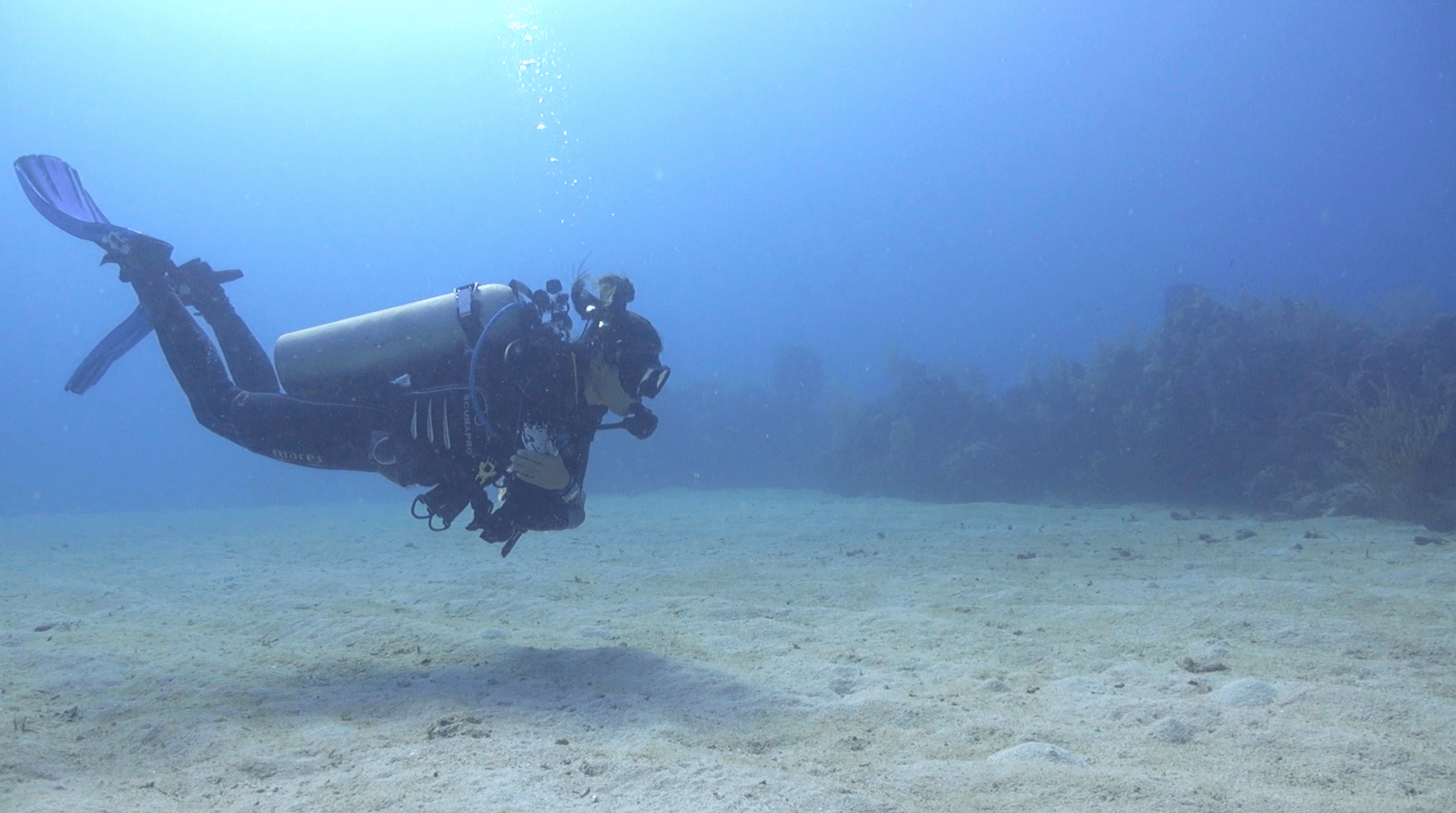
Instructor Eri demonstrating great buoyancy control.
Tip 1. Take a buoyancy course
Good buoyancy is the key to good air consumption. There are three main benefits of being weighted well and demonstrating good buoyancy: you don't waste a lot of air inflating and deflating your BCD, your breathing is more regulated and you use less energy.
Whenever we have Advanced Open Water Diver students, the first dive of the course that we always strongly recommend they complete is the Peak Performance Buoyancy dive. You learn how to weight yourself properly, how to swim in a good, efficient manner and how to use your lungs, not your BCD, to control your buoyancy. It's a really beneficial dive that improves people's diving for their entire diving careers, so it's a dive that should definitely not be missed.
Want to take it even further? Take an entire buoyancy specialty course, where you spend several dives focusing just on buoyancy. This will greatly improve your diving and your air consumption in the long run.
Tip 2. Be a yogi (or at least breathe like one)
A lot of people find that doing yoga benefits them as scuba divers. Even if you don't do yoga, it doesn't hurt to breathe like someone that does. Yoga breathing is very similar to how you should breathe in scuba diving. Nice, long deep breaths in and nice, long deep breaths out.
Breathing deeply not only improves your air consumption, but it improves your buoyancy control as well. Your lungs act as a secondary buoyancy control device, so breathing shallowly and holding air in your lugs will make you more positively buoyant. If you are positively buoyant on a dive, especially during your safety stop, it can stress you out and make you breathe even more shallow, further increasing your buoyancy. Breathing your air out deeply will help neutralize your buoyancy, so you get the double benefit of better air consumption, buoyancy control and less stress when you breathe deeply.
Tip 3. To take it further, try the 1:2 rule
When I first started diving, I wanted to see just how good I could get my air consumption, so I started a 1:2 rule to see if it made a difference. Breathe in for a certain number of seconds (4 seconds was comfortable for me) and breathe out for twice that period of time (8 seconds out). While it wasn't a type of breathing I would naturally do, focusing so much on my breathing and taking the time to not only breathe in slowly, but to also breathe out slowly, made a difference for my air consumption. Now, I can actually get two 60 minutes dives off of one tank if I am so inclined (I'm not normally so inclined, but it's had its benefits before).
Tip 4. Be efficient
Efficiency is the name of the game in scuba diving. Efficient kicking is important to decrease your energy consumption and breathing. When you're diving, you basically want to be hovering always with a gently kick or two every once in a while. Try not to use your arms as that will increase your energy consumption, and though you may not notice it, your breathing will increase as well. Watching your guide or instructor as they dive and see if they're being efficient. If they are, try to mimic them and see how it suits you! If they're flip-floppiting everywhere, then use them as your example of what not to do.
Tip 5. Be gentle with yourself
Being a good diver does not always come naturally to everyone. Some people are great divers on their first Discover Scuba Diving program. Some people require dozens of dives and lots of additional training before they become good, comfortable divers. Everyone is different. If your air consumption is faster than the others, that's okay. With time and some practice, your air consumption will improve, so give yourself a break and just enjoy yourself. The more stressed you are, the more you will breathe, so just relax and enjoy your dive!
So there you have it, 5 smart ways to improve your air consumption! Remember, the most important part of your scuba diving experience is to be mindful, smart, and most of all, have fun. Everything else will come in time, so enjoy the beautiful underwater world and you'll get a 60 minute dive before you know it!